India’s Solar Export Story Just Took a Major Hit..
September 2026,
For years, India built a genuine reputation as the alternative to China in global solar manufacturing — a trusted, lower-risk source for panels and cells as Western buyers looked to diversify their supply chains. That reputation just took a serious hit.
The US Department of Commerce has issued final affirmative determinations in its antidumping and countervailing duty investigations into crystalline silicon photovoltaic cells and modules imported from India, Indonesia, and Laos. In plain terms: Commerce has concluded that solar producers and exporters in these three countries sold products into the US market below fair value, while also benefiting from government subsidies — and that this caused real, material injury to US domestic solar manufacturers.
The Numbers
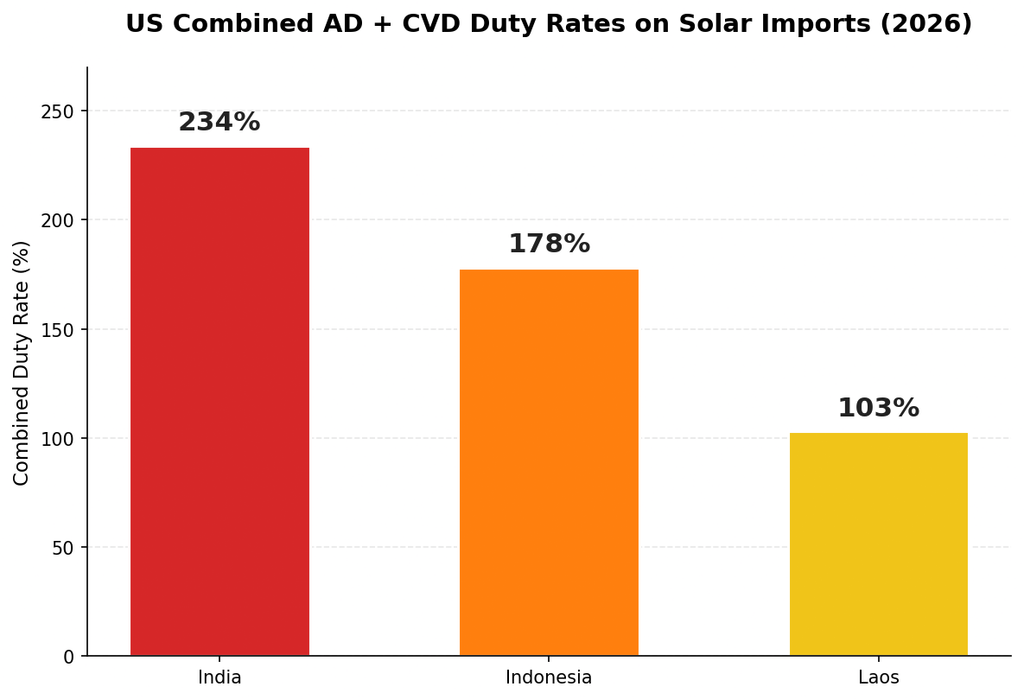
India came out with the steepest duties of the three countries under investigation:
- Countervailing duty (subsidy offset): approximately 126%
- Antidumping duty: approximately 123%
- Combined preliminary exposure: roughly 234%
For comparison, Indonesia’s combined rate landed between 121% and 178%, and Laos came in at around 103%. India didn’t just get caught up in this case — it drew the harshest treatment of the group.
How We Got Here
The case traces back to mid-2025, when a coalition of US domestic solar manufacturers formally petitioned the government for an investigation. Their core argument: as tariffs tightened on solar imports from China, Cambodia, Malaysia, Thailand, and Vietnam in earlier trade actions, a meaningful share of production simply relocated to India, Indonesia, and Laos — allowing the same underlying supply chains to route around existing tariffs rather than genuinely rebuilding manufacturing capacity in new locations.
The US International Trade Commission made a preliminary finding in August 2025 that domestic manufacturers were indeed being materially injured by these imports. From there, Commerce moved through its standard two-stage process — preliminary countervailing duty rates in February 2026, followed by preliminary antidumping rates in April 2026 — before finalizing both determinations this September.
Notably, some Indian exporters were also flagged under a “critical circumstances” finding, based on evidence that import volumes surged sharply in the months before the case was formally decided — a pattern regulators read as an attempt to rush shipments through ahead of the coming duties. That finding matters because it can allow duties to be applied retroactively, covering shipments made in the lead-up to the announcement, not just those going forward.
Why This Matters at Scale
This isn’t a niche trade dispute. India, Indonesia, and Laos combined accounted for roughly $4.5 billion in US solar imports in 2025 alone — close to two-thirds of all solar product volume entering the United States that year. A duty structure this steep effectively closes the door on India-origin solar being price-competitive in the US market, at least for as long as these rates hold.
What Happens Next
This case isn’t fully settled yet. The US International Trade Commission still has to deliver a final injury determination — the vote is scheduled for mid-October 2026. If the Commission finds affirmatively that US manufacturers were genuinely harmed, Commerce will issue official, enforceable duty orders in early November 2026, locking these cash deposit rates into place. If the Commission’s vote goes the other way, the case is terminated and deposits collected so far would be refunded.
Given the strength of Commerce’s own findings and the preliminary injury determination that already came back affirmative last year, most trade analysts expect the final outcome to uphold these duties rather than reverse them.
Our Take
Our own read on this, watching the market closely: duties at this level are likely to create a genuine supply chain problem for the US itself, not just a setback for Indian exporters. Domestic US module manufacturing capacity remains far too limited to absorb the volume that India, Indonesia, and Laos together were supplying, and with module prices already sitting in the mid-$0.40s range even before this ruling, the math for US buyers is about to get considerably harder. It remains to be seen exactly how the market adjusts from here — but for Indian module manufacturers specifically, the path forward into the US now looks genuinely difficult.
This isn’t unfamiliar territory, either. We’ve watched this exact pattern play out before with other Southeast Asian solar-exporting nations once AD/CVD orders were finalized against them — export volumes into the US didn’t just soften, they collapsed toward near-zero fairly quickly. There’s little reason to expect this case to unfold much differently for India.
We’ll be tracking the ITC’s final injury vote in October and the resulting duty order in November closely — subscribe to stay updated as this develops.
This is my personal read on where things are heading, not professional trade or investment advice. Markets and trade policy can shift quickly — always verify the latest official determinations before making business decisions based on this analysis.