Want Solar? How Much Solar Do You Really Need? Let’s Do the Math!
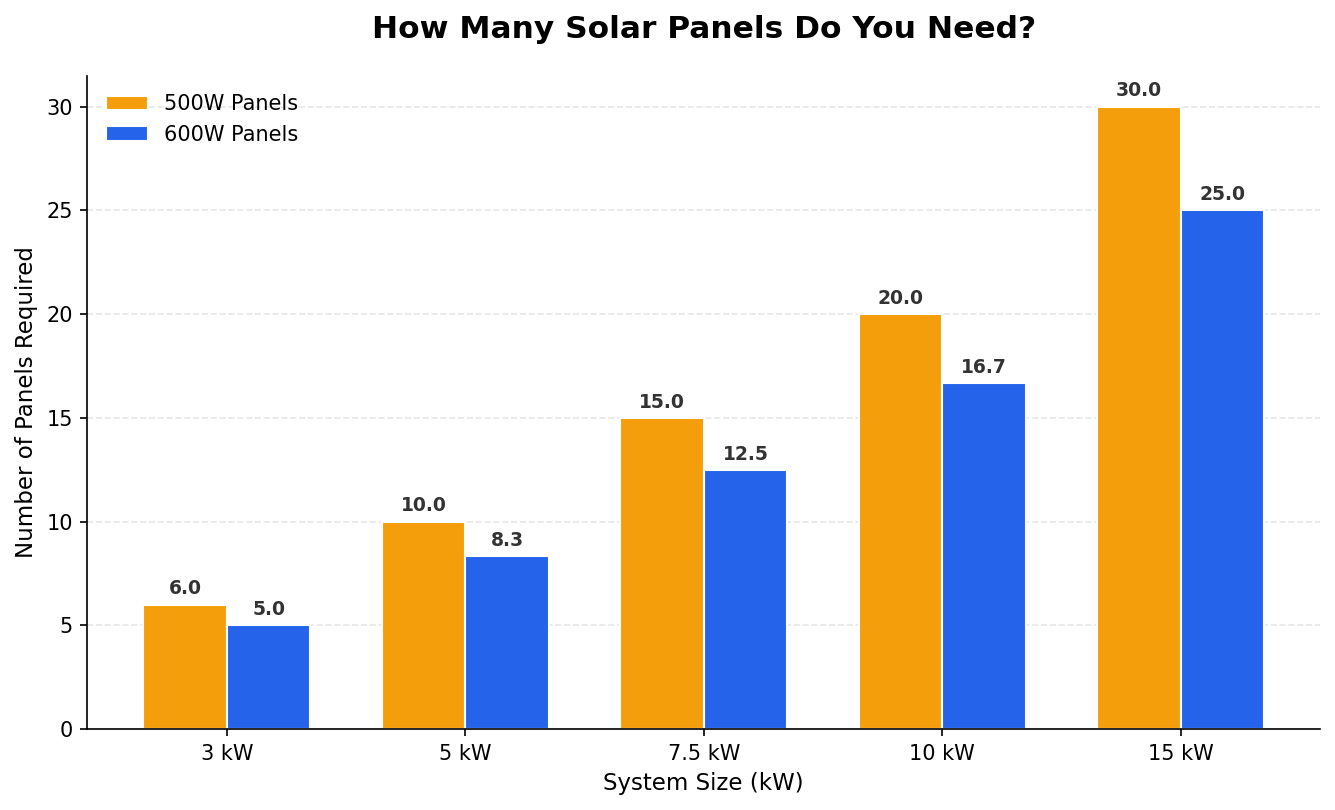
How Much Solar Power Do You Actually Need?
The honest answer: it depends on four things — how much electricity you consume, how much sunlight your location receives, the type of solar panels you use, and whether you have a battery.
The good news is you don’t need complicated engineering calculations to get a reasonably accurate estimate. Here’s how to work it out yourself, step by step.
Step 1: Start With Your Electricity Consumption
Pull out your last few electricity bills and find your monthly consumption in kWh (units).
| Monthly electricity consumption | Approximate daily consumption |
|---|---|
| 150 kWh | 5 kWh/day |
| 300 kWh | 10 kWh/day |
| 600 kWh | 20 kWh/day |
This number — your daily consumption — is the foundation everything else is built on.
Step 2: Understand Solar Hours at Your Location
Solar panels don’t produce their full rated output continuously through the day — output rises and falls with the sun’s position and intensity. Solar engineers formally account for this using a concept called Peak Sun Hours (PSH), but you don’t need to get into that level of detail for a first estimate.
Here’s the simple, practical shortcut: 1 kW of installed solar capacity typically generates around 4-5 units (kWh) of electricity per day in most reasonably sunny locations. So a 5 kW system would generate roughly 20 units/day, and a 10 kW system roughly 40-50 units/day.
Step 3: Work Out the System Size You Actually Need
Now combine steps 1 and 2. Take your daily consumption and divide it by the 4-5 units/kW generation rule to find your required system capacity.
Example: If you consume 20 kWh/day, and each kW of solar generates about 4 units/day:
20 ÷ 4 = 5 kW system required
This is your target capacity before you start picking specific panels.
Step 4: How Many Solar Panels Do You Need?
Once you know your required system capacity, the panel count is simple:
Number of panels = Required system capacity ÷ Panel wattage
Example: If you need 5 kW, and each panel is rated 500 W (0.5 kW):
5 ÷ 0.5 = 10 panels
If you instead use higher-wattage 600 W panels:
5 ÷ 0.6 = 8.33, so 9 panels (round up, since partial panels aren’t possible)
Modern panels commonly range from 500 W up to 610-620 W — higher-wattage panels mean fewer panels for the same total capacity, which can matter if your roof space is limited.
Step 5: Apply a Realistic Performance Ratio
Real-world solar systems never operate at 100% theoretical efficiency — losses come from panel temperature, wiring, inverter conversion, dust, and shading. A typical system performance ratio sits around 75-85% of the theoretical output.
This means it’s worth adding a small buffer to your calculated system size — if steps 1-4 point you to 5 kW, sizing slightly above that (say 5.5-6 kW) helps ensure you actually meet your consumption needs after real-world losses are accounted for.
Step 6: Check Whether Your Roof Has Enough Usable Area
Before finalizing anything, confirm your roof can physically fit the system. As a rule of thumb, 1 kW of solar capacity needs roughly 7-10 square meters of usable roof area, accounting for panel size, spacing, and mounting structure. A 5 kW system, for example, would typically need 35-50 square meters of clear, shade-free roof space.
Step 7: Check Local Grid, Net-Metering, and Electrical Requirements
Finally, check your local regulations before committing to a system size. Net-metering rules, grid-connection limits, and electrical codes vary by state and utility provider in India (and vary significantly by country if you’re evaluating this outside India) — some regions cap how much capacity you can install relative to your sanctioned load, or have specific requirements for grid-tied versus off-grid systems. This step can materially affect your final system size, so it’s worth confirming before you finalize panel count or place an order.
Putting It All Together
| Step | What you’re calculating |
|---|---|
| 1 | Daily electricity consumption (kWh) |
| 2 | Expected generation per kW (4-5 units/day rule) |
| 3 | Required system size (kW) |
| 4 | Number of panels needed |
| 5 | Buffer for real-world performance losses |
| 6 | Available roof space |
| 7 | Local grid/regulatory limits |
Walk through these seven steps with your own numbers, and you’ll land on a genuinely reasonable estimate — accurate enough to start real conversations with installers, without needing to hire an engineer just to get a starting point.
You’ve got the information. Now go turn some sunlight into savings !!!!!